Tanzania Grows the Beans. Almost Nobody in Tanzania Turns Them Into Butter.
Published 26 September 2026 · Commodities.tz Editorial
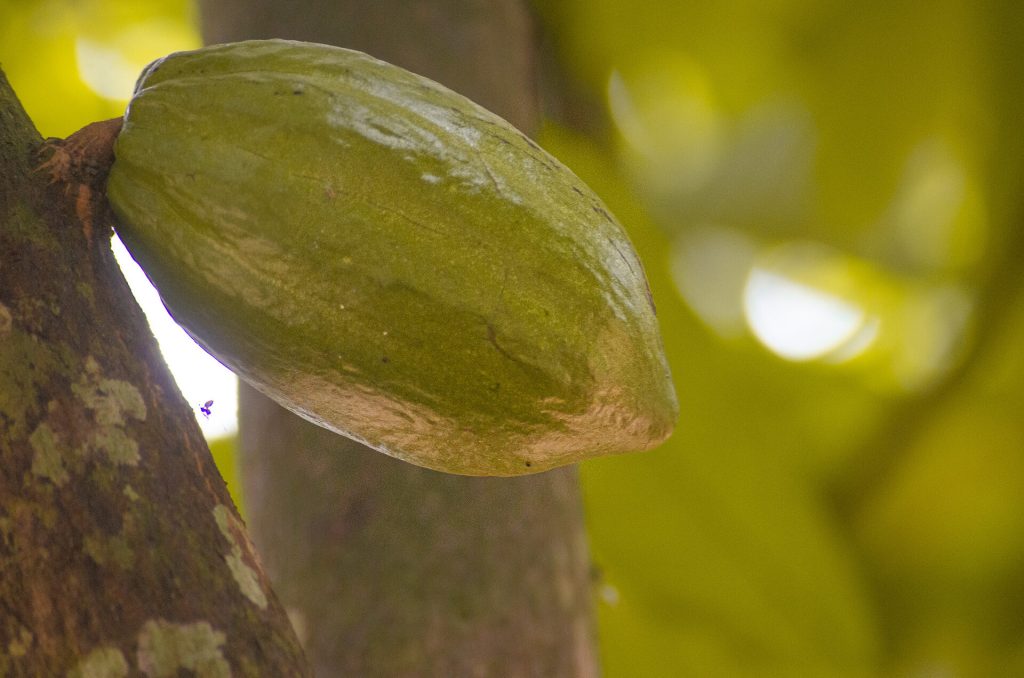
Cocoa’s journey from pod to finished chocolate ingredient runs through five distinct value-adding stages, and almost none of them currently happen inside Tanzania. Understanding exactly where the country’s cocoa sector stops — and where a district cooperative is trying to push it further — explains more about Tanzanian cocoa economics than production tonnage alone.
The five stages, and where Tanzania exits the chain
Per the International Cocoa Organization’s own description of the process: pods are cut from the tree and opened, wet beans are fermented for 36 to 72 hours to develop flavor precursors, then sun-dried until moisture drops from around 55% to roughly 7.5% for stable storage. That much — harvest, fermentation, drying — is done in Tanzania, mostly at farm or primary-cooperative level. The next three stages are not: roasting, followed by winnowing (separating the shell from the nib); grinding the nib into cocoa liquor; and finally pressing that liquor at up to 550 bars and 200°C to split it into cocoa butter and press-cake, which is then cooled and ground into cocoa powder. Each of those later stages is where most of cocoa’s processing value is added — and each is currently performed almost entirely outside Tanzania, on beans Tanzania has already exported.
What the trade numbers show
Tanzania produced roughly 15,000 tonnes of cocoa beans in 2024 — about 0.3% of global output, ranking 21st worldwide. On the export side, Tanzania ranked 11th among 80 cocoa-exporting countries in 2024, shipping beans worth roughly $103 million. Growth has been sharp: Bank of Tanzania’s Monthly Economic Review recorded cocoa export earnings of $89.4 million for the year ended November 2024, up 112.9% from $42.0 million the year before, a jump the Review attributed partly to “investments in high-quality production and value addition.” That phrase is worth reading precisely — the value addition driving Tanzania’s export growth is almost entirely about better fermentation, drying and sorting at origin (raising the price per kilo of raw beans), not about Tanzania performing the roasting-to-powder stages that capture the largest share of cocoa’s downstream value globally. Global grinding and re-export of processed cocoa is concentrated instead in Ivory Coast and Ghana (which together grow roughly 60% of the world’s beans and increasingly grind a share of them domestically) and in the Netherlands, Germany and Malaysia, which process and re-export cocoa butter and powder at industrial scale.
Kyela: an attempt to move one step up the chain
Kyela District in Mbeya Region produces around 80% of Tanzania’s total cocoa, which makes it the highest-leverage point in the country’s cocoa economy for any shift in processing capacity. In June 2025, the Kyela Cocoa Farmers’ Cooperative Union (KYECU) launched a self-financing initiative to build local processing capacity: a levy of 50 Tanzanian shillings per kilogram of cocoa sold, which in its pilot phase raised over TZS 500 million. So far, that money has funded quality-control equipment — 40 moisture meters, 40 digital weighing scales and 40 tablets distributed to primary agricultural cooperative societies — rather than the roasting-and-pressing factory itself, which union leadership has said is targeted for completion within two years. Kyela’s broader crop plan for the year to March 2027 sets a cocoa production target of 9 million kilograms at a reference price of TZS 10,000 per kilogram, aiming for roughly TZS 90 billion in cocoa revenue alone.
Why the distinction matters for buyers
For international buyers, this means Tanzanian cocoa today should be evaluated as a raw-bean origin — competing on fermentation quality, moisture control and defect rates rather than on any capacity to supply liquor, butter or powder directly. That could change if Kyela’s factory investment materializes on schedule, but as of now the value Tanzania captures from cocoa is set almost entirely at the bean stage, before the chain’s highest-value transformations even begin.
- Processing Cocoa — International Cocoa Organization — https://www.icco.org/processing-cocoa/ — 2026-09-26
- Cocoa farmers in Tanzania launch processing plant initiative to boost value addition, earnings — Food Business Africa — https://www.foodbusinessmea.com/cocoa-farmers-in-tanzania-launch-processing-plant-initiative-to-boost-value-addition-earnings/ — 2026-09-26
- Kyela eyes Sh100bn from four crops as farmers assured of market, prices — The Citizen — https://www.thecitizen.co.tz/tanzania/business/kyela-eyes-sh100bn-from-four-crops-as-farmers-assured-of-market-prices-5327184 — 2026-09-26
- Revealed: Top performers as Tanzania's exports jump 14pc — The Citizen (citing Bank of Tanzania Monthly Economic Review) — https://www.thecitizen.co.tz/tanzania/news/national/revealed-top-performers-as-tanzania-s-exports-jump-14pc-4883610 — 2026-09-26
- Tanzania cocoa production/export rankings (2024) — Trading Economics / trade data aggregation — https://tradingeconomics.com/tanzania/exports/cocoa-cocoa-preparations — 2026-09-26